Exploring mathematics with beads supports hands-on understanding of numbers, counting, and place value. This guide highlights five engaging bead-based math toys from Amazon that help young learners connect quantity with numerals, perfect for preschool to early elementary ages. Each item focuses on tactile learning, color differentiation, and Montessori-inspired methods to build foundational math skills.
Summary Table
| Product | Brand | Key Focus |
|---|---|---|
| Kghios Montessori Math Toys Materials (1–10 Bead Chains) | Kghios | Color counting, number relationship |
| Melissa & Doug Abacus Classic Wooden Toy | Melissa & Doug | Counting, patterns, color recognition |
| Kghios Golden Beads Decimal System Bank Game | Kghios | Decimal concepts, arithmetic operations |
| Adena Montessori Counting Beads Checker Board | Adena Montessori | Counting, number sense, safe materials |
| Ranqibo Wooden Abacus for Kids | Ranqibo | Base-10 blocks, counting sticks |
Kghios Montessori Bead Chains 1–10

The Kghios Bead Chains introduce early numeracy through color-coded beads on ten strings, each representing numbers 1 through 10. Designed for children aged three and up, the set uses ten bead colors, promoting color naming and matching alongside arithmetic exploration. Beads are compact (approximately 0.8 cm), allowing young learners to handle quantities physically, which supports intuitive understanding of numerical relationships and basic addition or subtraction concepts.
Kghios Decimals Bank Game
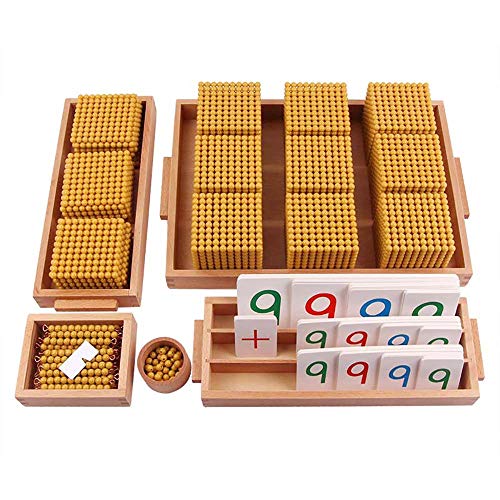
This decimal system set uses beech wood and plastic components to simulate bank-style operations with 1000s, 100s, 10s, and units. The assortment includes 9 pieces of 1000-position beads, 45 pieces each of other positions, plus card sets and calculation symbols. It supports operation-based learning (addition, subtraction, multiplication, division) and helps children see how place value connects with numerical operations in a tactile way.
Adena Counting Beads Checker Board

Adena Montessori Counting Beads provide engaging counting materials housed in a sturdy beech wood box. The acrylic beads are chosen for safety and colorfulness, designed to capture attention while teaching fundamental counting and number sense. The set emphasizes durability and easy storage, making it suitable for regular use in both home and classroom settings as learners build confidence with numbers from 1 upward.
Ranqibo Wood Abacus With Beads

The Ranqibo abacus combines a traditional wooden frame with 10 counting columns and 100 beads, complemented by number cards and counting sticks. Suitable for ages around 3 and up, this tool supports early math skills including one-to-one counting, base-10 concepts, and basic addition and subtraction. The compact design makes it a portable option for classroom centers or home study.
WRYBV Silicone Bead Math Set

WRYBV offers a colorful set featuring silicone beads, chopsticks, and spoons designed for arithmetic practice. The combination supports counting, pattern creation, and fine motor skills while encouraging interactive, hands-on problem-solving. The colorful beads promote visual differentiation, and the included tools help children practice sorting and counting with precision.
Buying Guide: Key Purchase Considerations
- Age appropriateness: Choose sets labeled for toddlers or preschoolers to ensure the activities match developmental stages and safety requirements.
- Material quality: Look for durable woods, safe plastics, and non-toxic finishes. Solid construction reduces breakage and extends playtime value.
- Educational focus: Decide whether you want decimal/system concepts (place value), basic counting, or early arithmetic. Different kits emphasize different goals.
- Hands-on engagement: Beads, strings, and counting sticks should invite manipulation rather than passive observation, supporting kinesthetic learning.
- Storage and organization: Sets with storage solutions help children maintain tidy learning spaces and encourage independent cleanup.
- Compatibility with curriculum: If you’re aligning with Montessori principles or homeschool math plans, favor tools that mirror those methodologies.
- Safety considerations: Ensure smooth edges and age-appropriate components to minimize choking hazards and injuries during play.
- Price-to-value balance: Compare the number of pieces and features across sets to determine which provides the best long-term learning value.
- Multi-sensory options: Some kits combine visual color-coding with tactile beads, enhancing memory and concept retention through multiple senses.
- Future-proofing: Look for modular options that expand from counting to more advanced concepts like place value and basic operations as a child grows.
These bead-based math tools collectively support a progression from concrete counting to abstract numerical reasoning. When selecting a kit, consider how it complements your child’s current skills and your teaching approach, whether at home or in a classroom setting.