Foam filament blends bring lightweighting and tactile softness to 3D printed parts, expanding possibilities from wearable tech to lightweight drones. This guide reviews top foam filaments that deliver real foaming effects, adjustable hardness, and reliable print performance. We examine how to choose materials, compare their foaming behavior, and weigh trade-offs like surface finish, strength, and print compatibility. The selections below highlight options with active foaming technology, varying densities, and surface textures to suit multiple project needs.
| Product | Brand | Foaming Type | Approx. Filament |
|---|---|---|---|
| Siraya Tech Flex TPU Air – Black | Siraya Tech | Active foaming; adjustable hardness 65A-82A | 1 kg |
| eSUN PLA LW | eSUN | Lightweight foaming PLA; high foaming volume | 1 kg |
| Siraya Tech Flex TPU Air – Green | Siraya Tech | Active foaming; adjustable hardness 65A-82A | 1 kg |
| Siraya Tech Flex TPU Air – White | Siraya Tech | Active foaming; adjustable hardness 65A-82A | 1 kg |
| SainSmart LW PLA | SainSmart | Lightweight LW-PLA; active foaming | 1 kg |
Siraya Tech Flex TPU Air – Black

Siraya Tech Flex TPU Air in black combines adjustable hardness with active foaming to reduce weight by up to 50% without sacrificing elasticity. Printing at lower temperatures yields tougher parts, while higher temperatures initiate foaming for a lighter, softer feel. The surface offers a comfortable fabric-like texture, suitable for wearables, grips, and soft prototypes that contact skin. This filament supports high-speed printing and is designed for quick-to-market soft prototypes and durable wearable components.
eSUN PLA LW – Natural

eSUN PLA LW uses active foaming technology to achieve a high foaming volume ratio, up to 220%. This allows one roll of LW-PLA to equal roughly two rolls of standard PLA for weight-conscious models. The filament is designed to minimize clogging and tangling thanks to careful winding and handling, delivering reliable prints for large parts. It also supports easy painting and broad applications, including model airplanes, drones, and cosplay props where weight savings are critical.
Siraya Tech Flex TPU Air – Green
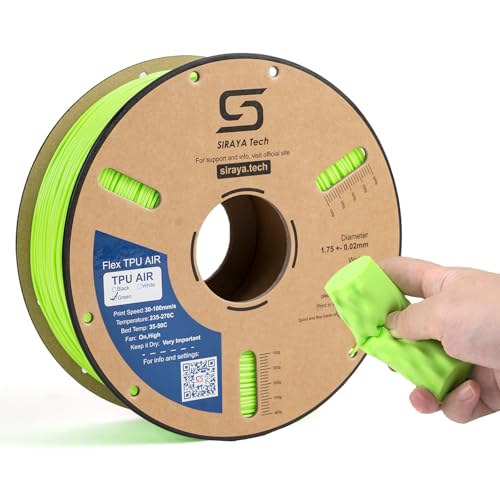
The green variant of TPU Air maintains the same adjustable hardness from 65A to 82A with active foaming. It balances weight reduction with durability and offers a soft-touch finish ideal for wearable devices and protective grips. The material enables flexible prints at high-speed settings while preserving part integrity, making it well-suited for soft prototypes and sports gear components that require skin-friendly surfaces.
Siraya Tech Flex TPU Air – White

The white variant also supports adjustable hardness and active foaming, delivering a fabric-like surface texture similar to other TPU Air colors. White TPU Aer prints suit wearables, grips, and soft prototyping with skin-contact requirements. Its foaming approach reduces weight while maintaining elasticity and toughness, enabling comfortable everyday accessories and lightweight forms with strong durability.
SainSmart LW PLA – White

SainSmart LW PLA combines lightweight, low-density foam with controllable expansion. Its density reduction supports applications in RC planes and drones where wing loading and stall speed are critical. The LW-PLA filament supports dynamic foaming control through temperature and speed adjustments, enabling varied density within a single print. It’s positioned for users seeking strong-to-weight optimized parts with customization potential in density and strength.
Buying Guide: Key Considerations for Foam Filaments
- Foaming mechanism and density control: Evaluate whether the filament uses active foaming during printing and how to adjust hardness and weight. Some filaments offer a wide hardness range (e.g., 65A–82A) and weight reduction up to 50% or more.
- Material compatibility and finish: TPU-based foams provide flexible, skin-friendly surfaces ideal for wearables; PLA-based foam focuses on lightness and ease of painting. Consider the desired surface texture (fabric-like, matte, or smooth) and post-processing needs.
- Print settings and reliability: Check nozzle temperature ranges, bed requirements, and potential for clogging or warping. Filaments with clean winding and anti-tangle design reduce print failures on large models.
- Strength-to-weight balance: Weigh the trade-offs between part strength, elasticity, and weight savings. For aerospace or RC applications, foam density and structure influence performance.
- Color and aesthetic options: Filaments are offered in multiple colors (black, green, white) to match design goals. Color can affect surface finish and post-processing steps such as painting.
- Applications and use cases: Wearables and grips demand skin-friendly textures, while model aircraft and cosplay props prioritize lightness and paint adhesion. Align the filament choice with end-use requirements.
- Printer compatibility and warranty: Confirm compatibility with your printer’s hot-end, nozzle size, and firmware. Some foaming filaments require careful temperature control to prevent over-foaming or under-foaming.
- Cost and availability: Evaluate the cost per kilogram in relation to performance, especially for large or repetitive parts. Availability may vary by color and family (PLA LW vs. TPU Air).
Choosing the right foam filament involves balancing weight reduction, surface feel, and mechanical performance for your specific project. When selecting, consider the required density, tactile quality, and whether your printer can consistently reproduce the foaming behavior without compromising part integrity. Testing small prints before scaling up helps verify that the chosen filament meets your design criteria and production timelines.