For engineers and hobbyists, PC carbon fiber filaments blend the toughness of polycarbonate with the stiffness of carbon fiber. This guide highlights top PC-CF options available on Amazon, aiming to balance printability, heat tolerance, dimensional stability, and strength for functional parts and prototypes. Each product section includes a quick overview and practical printing notes to help you compare performance at a glance.
| Product | Key Benefit | Approximate Temperature | Dimensional Stability |
|---|---|---|---|
| YXPOLYER PC-CF Filament | Stiff, strong with 15% CF reinforcement | Up to 140°C | Good dimensional accuracy |
| IEMAI PC CF Filament | Excellent mechanical strength and rigidity | Up to 147°C | ±0.02 mm |
| PRILINE Carbon Fiber Filament | High stiffness and environmental resistance | High temp performance | Engineered for structural parts |
| iSANGHU PC-CF Filament | 20% carbon fiber for improved stability | High-temperature applications | Excellent dimensional stability |
| ELEGOO Carbon Fiber PLA Filament | Strong and smooth with carbon fiber reinforcement | Good layer adhesion | Consistent prints |
YXPOLYER PC-CF Filament Review

Specification highlights include a 1.75 mm diameter version, 1 kg spool, and a carbon fiber reinforcement that enhances stiffness, dimensional stability, and heat resistance. The filament is designed to reduce warping while maintaining good flexural strength and elongation. Printing is optimized at higher nozzle temperatures (about 280°C) to achieve strong layer adhesion. The included 15% carbon fiber reinforcement offers a balanced performance, supporting complex geometries with easy air-pruning and clean removal of supports in many prints.
IEMAI PC CF 3D Printer Filament

IEMAI pairs 20% carbon fiber with polycarbonate to deliver high tensile strength, stiffness, and impact resistance. The filament targets engineering-grade parts, brackets, and fixtures that endure heat and mechanical load. It maintains mechanical integrity up to 147°C and shows strong dimensional accuracy within ±0.02 mm. The output typically exhibits reduced warping and reliable layer adhesion, making it suitable for large functional prints and prototypes where precise tolerances matter.
PRILINE Carbon Fiber Filament
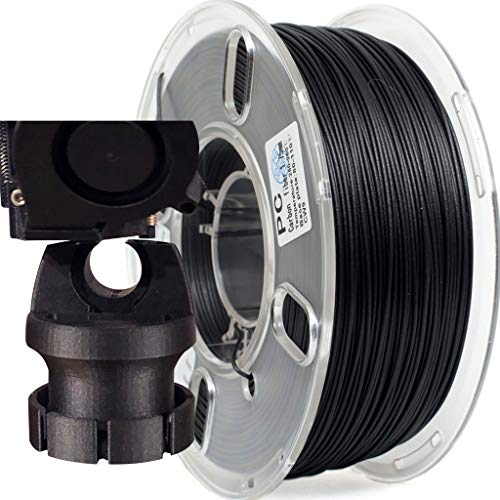
PRILINE’s carbon fiber-infused polycarbonate filament emphasizes high strength and stiffness, making it a solid choice for engineering-grade structural parts. The formulation aims to balance hardness, tenacity, and environmental resilience, with a focus on printability and reduced odor during printing. It products parts capable of withstanding demanding loads while maintaining dimensional stability, ideal where durable, heat-tolerant components are required.
iSANGHU Carbon Fiber PC Filament

iSANGHU’s PC-CF filament blends 20% high-modulus carbon fibers with polycarbonate to deliver enhanced thermal properties, strength, stiffness, and surface finish. Notable advantages include improved dimensional stability, UV and chemical resistance, and sustained mechanical integrity under elevated temperatures. The filament is suitable for outdoor components, housings, and other high-temperature parts that require reliable performance in harsh environments.
ELEGOO Carbon Fiber PLA Filament

ELEGOO’s PLA-CF filament uses carbon fiber reinforcement to boost strength and stiffness while preserving legible printability. It generally benefits from good layer adhesion, dimensional accuracy within ±0.02 mm, and a stable extrusion experience. This option is well-suited for beginners and seasoned printers seeking stronger, more impact-resistant PLA prints with smoother surface finishes.
YXPOLYER PC Carbon Fiber 50g Filament

This smaller 50 g variant still showcases the core advantages of PC-CF: high strength, excellent heat resistance up to about 140°C, and low water absorption with reduced shrinkage. It targets quick tests, small parts, and performance-focused prototypes where carbon fiber reinforcement yields meaningful gains in stiffness and durability.
Summary Of Filament Options
PC carbon fiber filaments come in a range of chemistries and fiber loadings. Common strengths include higher heat resistance, improved stiffness, and better dimensional stability versus standard PC or PLA. Print temperature, bed temperature, and cooling strategies vary by brand, so consult each supplier’s recommended settings. For parts with complex geometry, CF reinforcement often aids print fidelity and reduces warping. For outdoor or high-temperature applications, select formulations with higher Tg and UV/chemical resistance.
Buying Guide: Key Purchase Considerations
- Print Temperature and Bed Conditions — PC-CF materials typically require higher nozzle temperatures and stable bed adhesion. Confirm your printer supports the recommended range (often around 260–280°C nozzle, with appropriate bed temperature).
- Carbon Fiber Loading — Filaments commonly use 15–20% CF; higher loadings increase stiffness but can raise brittleness and nozzle wear. Consider your tolerance for wear and required part toughness.
- Dimensional Stability — Look for tight tolerances (±0.02 mm is common) to ensure precise fits on assemblies and jigs. Lower warp formulations are advantageous for large parts.
- Heat Resistance — Tg or heat tolerance (often 140–147°C) is critical for parts exposed to heat. Choose a formulation aligned with your operating temperatures.
- Printing Environment — CF filaments can be more abrasive to nozzles (consider hardened steel nozzles) and may require enclosed or temperature-controlled enclosures for consistent results.
- Print Quality vs. Ease of Use — Some PC-CF blends print with good surface finishes but require careful parameter tuning. Others are more beginner-friendly but may provide slightly lower performance gains.
- Mechanical Requirements — For load-bearing or functional components, prioritize combinations of stiffness, impact resistance, and dimensional stability. For outdoor use, emphasize UV and chemical resistance.
- Compatibility — Verify filament diameter (1.75 mm is standard in this list) and spool safety (reusable or moisture-protected packaging) to minimize printing interruptions.
- Cost and Availability — Compare spool sizes and pricing to estimate project costs. Larger spool options often reduce long-term costs for ongoing projects.
- Post-Processing — Some CF prints respond well to light sanding or acetone smoothing for smoother surfaces; others may show fiber lines that benefit from surface finishing techniques.