Finding a laser system that delivers clean leather cuts with minimal setup can transform crafting, prototyping, and custom production. This guide highlights five high-performing laser engravers and cutters capable of detailed leather work, from beginner-friendly units to industrial-capable machines. Each option balances engraving precision, cutting capability, and user-friendly features so you can choose what best fits your project load and budget. Below is a quick overview of the featured models to help you compare capabilities at a glance.
| Product | Brand | Laser Power | Working Area |
|---|---|---|---|
| ACMER S1 (3500mW) | ACMER | 3500mW | 130×130 mm |
| Carverall K15 Pro (5W) | Carverall | 5W | 200×300 mm |
| Longer RAY5 (20000mW) | Longer | 20000mW | 400×400 mm |
| ACMER S1 (2500mW) | ACMER | 2500mW | 130×130 mm |
| Creality Falcon 5W | CREALITY FALCON | 5W | 400×415 mm |
The following sections present each model with a concise overview focused on leather work, followed by practical buying considerations to help you select a machine that aligns with your leather craft needs, whether you create wallets, belts, bags, or decorative pieces.
ACMER S1 Laser Engraver 3500mW For Leather And More

The Acmer S1 3500mW system combines high-precision engraving with versatile 2-in-1 cutting and engraving on leather, wood, acrylic, and more. Its 0.04 mm laser spot and 2 mm focal length support fine detailing ideal for leather accessories and small-batch items. A fast 10,000 mm/min engraving speed and repeatable 0.01 mm positioning accuracy help ensure repeatable results across multiple dies or designs. The unit ships nearly preassembled, reducing setup time for beginners and professionals alike, making it suitable for hobbyists and small businesses aiming for quick iteration cycles.
Carverall K15 Pro 5W Laser Engraving Machine
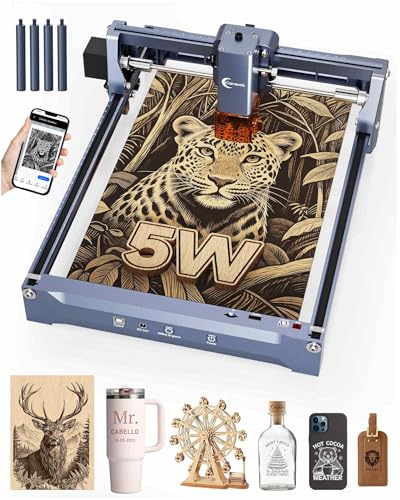
The Carverall K15 Pro offers a true 5W laser output, delivering reliable engraving and cutting on leather, wood, coated metals, and more. With 0.01 mm precision and speeds up to 15,000 mm/min, it enables detailed leather patterns, monograms, and decorative cuts. The device emphasizes compatibility via CutLabX and common software ecosystems, allowing easy integration with LightBurn and LaserGRBL. A compact, portable design and minimal assembly suit beginners who want professional-quality results without a steep learning curve.
Longer RAY5 20000mW Laser Engraver

The Longer RAY5 stands out with a 20000 mW output, enabling deeper cuts and faster material removal on leather when needed. It features a 256-color palette for engraving effects and precise 0.01 mm accuracy, supporting multi-color leather projects and intricate designs. Its 400×400 mm workspace and ESP32-based chipset allow multi-machine coordination, which can be valuable for larger leather panels or batch production while maintaining consistent quality.
ACMER S1 2500mW Leather Engraver
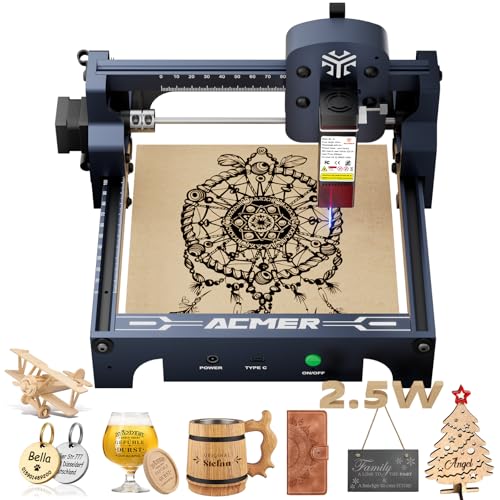
This variant of the ACmer S1 combines compact dimensions with 2500mW power for detailed leather engraving and light cutting tasks. The same 0.01 mm repeatability and 10,000 mm/min speed deliver precise monograms, textures, and decorative edges on leather pieces such as wallets and tags. The 130×130 mm working area fits small leather components, while the device’s simplicity supports quick setup and straightforward operation for hobbyists and small studios.
ACMER S1 6000mW Leather Engraver

The 6000 mW ACmer S1 model offers higher power for deeper and faster cuts on leather, while maintaining the 130×130 mm working area and 0.04 mm laser spot. With a robust 48W output and the same 455±5 nm wavelength, this unit suits heavier leather goods or thicker hides. It remains user-friendly with quick setup and reliable repeatability, making it a strong option for small shops expanding from hobby projects into production runs.
Creality Falcon 5W Laser Engraver
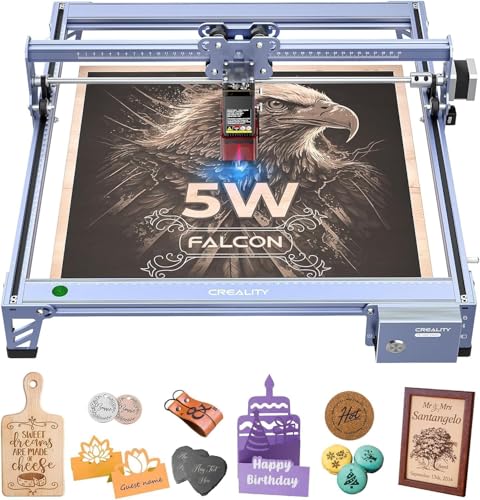
Creality Falcon combines a 5W laser with a large working area of 400×415 mm, enabling broader leather projects such as belts, handbags, or multiple panels in one pass. The 0.06 mm spot size and sub-millimeter precision ensure crisp detailing, while a 32-bit control chip supports faster engraving at up to 10,000 mm/min. The larger bed size, along with potential upgrades like a rotary roller, makes it suitable for mid-to-large leather production tasks and more ambitious designs.
Buying Guide: Key Purchase Considerations For Leather Projects
When choosing a laser system for leather, consider these dimensions to align with your use case and budget:
- Power vs. Material Thickness: Higher wattage enables deeper cuts and faster processing of thicker leather, but may waste energy on thin hides. For wallets and thin belts, mid-range power often suffices; for thicker hides or multiple passes, higher wattage like 5W–20W models offer better performance.
- Working Area And Throughput: Leather projects vary from small tags to large belts. A compact 130×130 mm bed is great for small components, while 400×415 mm or larger beds support full panels and batch runs. Consider future expansion needs.
- Engraving vs. Cutting Quality: Pay attention to spot size and focal length. Finer spot sizes yield crisper engravings; deeper cuts require careful material selection and multi-pass strategies.
- Software Compatibility: Native support for popular tools (LightBurn, LaserGRBL or CutLabX) reduces setup friction. Cross-compatibility with Windows, macOS, and mobile platforms is a plus for studios with varied devices.
- Ease Of Use: Preassembled units or quick-start setups help beginners. Robust safety features (enclosure, eye protection) and straightforward maintenance contribute to consistent results.
- Reliability For Production: If planning multiple units or extended hours, consider devices designed for continuous operation with stable power supplies and good heat management.
- Expandability: Rotary attachments for cylindrical items, raft or bed upgrades, and accessories like supports or risers can extend capabilities for leather goods beyond flat panels.
In summary, for small leather workshops prioritizing ease and versatility, mid-power options with compact beds are ideal. For larger leather production or more intricate multi-color effects, higher-power systems with bigger working areas and multi-machine coordination offer greater efficiency and design flexibility.