Carbon fiber filament blends deliver higher stiffness, strength, and wear resistance for demanding parts while remaining printable on standard FDM/FFF 3D printers. This guide reviews top options, comparing strength, printability, and application fit. Learn how to choose carbon fiber filaments for structural parts, lightweight components, and high-widelity models without sacrificing ease of use.
The following table highlights five high-performing carbon fiber filaments from trusted brands, with quick references to their key strengths and intended uses.
| Product | Material Type | Diameter | Notable Strength | |
|---|---|---|---|---|
| PRILINE Carbon Fiber Polycarbonate Filament | Carbon Fiber Polycarbonate | 1.75 mm | High hardness and tenacity for engineering parts | Structural, load-bearing components |
| ELEGOO Carbon Fiber PLA Filament | PLA with Carbon Fiber | 1.75 mm | Excellent strength and dimensional stability | Durable prototypes, tool handles, brackets |
| OVERTURE PLA Carbon Fiber Filament | PLA with Carbon Fiber | 1.75 mm | High stiffness and precise dimensional accuracy | Rigid parts, aerospace-like components |
| FLASHFORGE PETG Carbon Fiber Filament | PETG with Carbon Fiber | 1.75 mm | Improved wear resistance and heat stability | Gears, bearings, high-friction parts |
| Official Creality Hyper PLA-CF Filament | PLA with Carbon Fiber | 1.75 mm | High-speed printing with strong mechanical properties | Structural parts, frames, joints |
Note: This article omits price references and focuses on material properties, print performance, and typical applications to help you decide which filament best fits your project goals and printer capabilities.
PRILINE Carbon Fiber Polycarbonate Filament
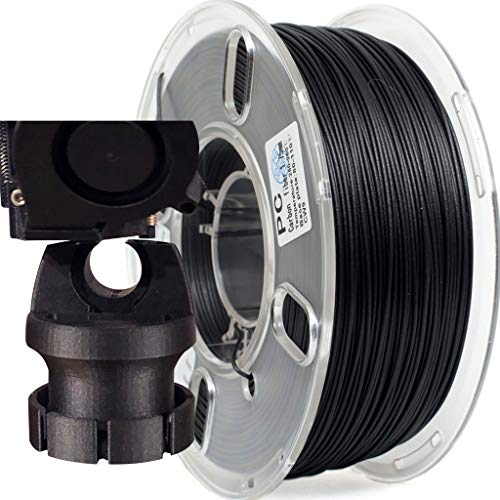
PRILINE Carbon Fiber Polycarbonate filament blends chopped carbon fiber infill with polycarbonate for high strength and rigidity. It is described as an engineering-grade material suitable for structural parts requiring stiffness and tenacity. The filament is noted for environmental resilience and low odor during printing, with weather and chemical resistance advantages. Users may need careful dial-in to optimize print settings for best results.
FLASHFORGE Carbon Fiber PLA Filament

FLASHFORGE Carbon Fiber PLA Filament is a PLA-CF blend designed to deliver enhanced strength and rigidity while remaining lightweight. The material aims to balance improved mechanical properties with easy printability, making it a popular choice for aerospace-inspired or load-bearing prototypes. It is described as ideal for applications that require higher strength without significant weight penalties.
ELEGOO Carbon Fiber PLA Filament

ELEGOO Carbon Fiber PLA Filament is reinforced with carbon fiber to deliver superior strength and stiffness. It emphasizes improved layer adhesion and a smoother surface finish with reduced visible layer lines. The filament’s tight winding and precise diameter tolerance (±0.02 mm) contribute to consistent feeding and fewer tangling issues during prints.
OVERTURE PLA Carbon Fiber Filament
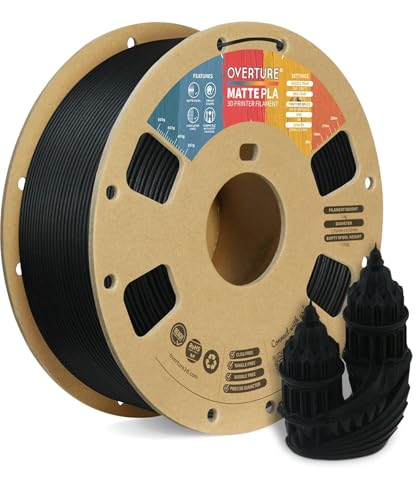
OVERTURE Carbon Fiber PLA provides high stiffness and strength, with careful dimensional accuracy and consistency using advanced CCD diameter measurement. The filament emphasizes tidy winding and minimal tangling to avoid line snapping, aiming for predictable performance on most FDM 3D printers. It is positioned for applications requiring robust PLA with carbon reinforcement.
Creality Hyper PLA-CF Filament

Creality Hyper PLA-CF Filament offers high-speed printing with carbon fiber reinforcement. It claims a balance of strength, adhesion, and speed, with improved mechanical properties over standard PLA. This filament is suitable for structural applications requiring faster print times without sacrificing part integrity on compatible FDM printers.
Creality Carbon Fiber Filament

Creality’s carbon fiber filament line emphasizes low warp and easy feeding, with 0.03 mm dimensional accuracy in some offerings. The material aims to deliver uniform color and enhanced toughness, facilitating easier printing of complex shapes and reliable performance in hobbyist to advanced projects. It is advertised as suitable for a range of K1 and K1 Max printers among others.
Buying Guide: Key Purchase Considerations And Comparisons
When selecting carbon fiber filaments, consider the blend type, printer compatibility, and end-use requirements. Carbon fiber composites come in PLA-CF, PETG-CF, and Polycarbonate-CF formulations, each with distinct trade-offs.
- Printability vs. strength: PLA-CF blends are easier to print and offer good rigidity, while PC-CF blends provide higher heat resistance and stiffness but may require higher printing temperatures and careful bed preparation.
- Diameter tolerance and winding: Look for filaments with tight tolerances (±0.02 mm or better) and well-wound spools to prevent jams and tangling during long prints.
- Printer compatibility: Check your hot end temperature range and nozzle material. Carbon fiber composites can be abrasive; consider hardened steel nozzles if you print frequently with CF filaments.
- Moisture sensitivity: Some CF filaments are hygroscopic. Drying and proper storage (desiccant, sealed bags) help maintain print quality and reduce bubbling or poor layer adhesion.
- Application fit: For lightweight structural parts, PLA-CF or PETG-CF may suffice. For heat-intensive environments, PC-CF blends are advantageous, though they may require more robust printers and enclosure control.
- Post-processing: CF filaments can leave scuff marks on tooling and may require careful finishing. Some parts benefit from sanding with fine grits or ultrasonic cleaning for smoother surfaces.
- Safety and odors: Most CF filaments are reported to emit minimal odor, but proper ventilation is still advisable during high-temperature prints.
In practice, reviewers often note that carbon fiber filaments require some dialing-in of print settings, including extrusion temperature, nozzle height, and print speed. Starting with manufacturer-recommended profiles and gradually adjusting for your specific printer can yield the best results. For complex or load-bearing parts, validate designs with prototypes before producing final components.