Finding a reliable 4-head screen printing machine can boost productivity for small apparel workshops and hobbyists. The following selections emphasize stability, 360° rotable heads, and double-layer positioning to minimize misalignment. Each model listed below suits limited spaces while offering scalable options from 1 to 4 stations. Explore 4-color configurations that support multiple projects—great for T-shirts, bags, and flat materials.
| Product | Color | Stations | ||
|---|---|---|---|---|
| VEVOR 4 Color 4 Station Screen Printing Machine | Multi | 4 | 21.2 x 17.7 in / 54 x 45 cm | Double-layer positioning, robust steel build |
| VEVOR 4 Color 2 Station Screen Printing Machine | Multi | 2 | 21.2 x 17.7 in / 54 x 45 cm | 360° rotable, independent bearings |
| HayWHNKN 4 Color 2 Station Screen Printing Machine | HayWHNKN | 2 | 21.2 x 17.7 in / 54 x 45 cm | Double-station, adjustable angles, spring tension |
| HayWHNKN 4 Color 1 Station Screen Printing Machine | HayWHNKN | 1 | 21.2 x 17.7 in / 54 x 45 cm | 360° rotatable head, micro-registration option |
| VEVOR 4 Color 2 Station (Low-Profile) | VEVOR | 2 | 21.2 x 17.7 in / 54 x 45 cm | Sturdy table-type design, compact footprint |
Note: All models share a focus on space efficiency, stable positioning, and 360° head rotation to accommodate flat-surface printing across textiles and other materials.
VEVOR 4 Color 4 Station Screen Printer

The 4 Color 4 Station model offers a compact footprint with a 21.2 x 17.7 in printing area and a double-layer positioning pallet. The fuselage screws onto a workbench for enhanced stability, and the 360° rotable head is supported by independent metal bearings to maintain accurate alignment during multi-color prints. The design emphasizes minimal space usage, making it ideal for hobbyists or small setups that occasionally run full-color runs. The machine supports a broad range of flat materials, including clothing, fabrics, plastics, and more, with a focus on consistent registration due to the under-arm position stops.
VEVOR 4 Color 1 Station Silk Screen Printer

This 1-station option keeps a similar footprint and construction quality as the larger models, with a 21.2 x 17.7 in printing area and a double-layer pallet for precise alignment. The independent metal bearings in the 360° rotatable fuselage ensure reliable positioning per color layer. It is especially suitable for smaller print runs and single-color designs on T-shirts, pillowcases, or other flat surfaces. The kit-like nature of the design often makes it easier to assemble on a home workbench while still delivering multi-material compatibility.
VEVOR 4 Color 2 Station Screen Printer

This 2-station version is designed for faster cycles with a balanced, dual-head workflow. The 360° rotating fuselage and independent bearings promote smooth, repeatable color placement. The double-layer positioning pallet reduces deviation risk, while the all-steel construction adds longevity. Printing area remains the same at 54 x 45 cm, enabling reliable textile and flat material printing with two simultaneous stations for efficiency gains.
4 Color Silk Screen Printing Kit 4 Station

This kit combines a 4-color, 4-station layout with rotating arms for 360° operation. It includes micro-registration features via adjustable screws for precise frame placement, and locating dents plus wheels to lock frames during printing. The design emphasizes stability through springs that help the frame stay in place after printing, with adjustable tension to accommodate different frame weights. Suitable for garments and numerous flat substrates including metal, plastic, wood, and ceramics.
VEVOR 4 Color 2 Station Silk Printer Kit

This 4 Color 2 Station kit combines table-type design with stable mechanical components and precise positioning. The electrostatic spraying and electroplating finish resist wear and corrosion, supporting longer-term use in busy environments. A compact footprint is paired with a robust build to enable efficient dual-station color printing on shirts, bags, and other flat goods. The dual-station setup reduces downtime between color layers and improves throughput on small runs.
HayWHNKN 4 Color 1 Station Silk Screen Printer
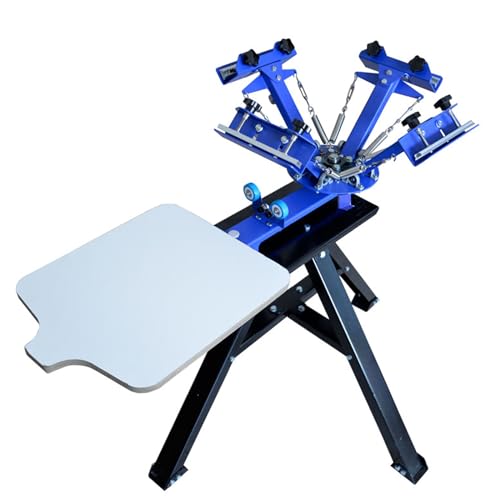
The HayWHNKN 4 Color 1 Station model emphasizes accurate printing with a screwed bracket and a 360° rotating head. A locating detent on each frame bracket helps lock the frame into alignment, while a spring-adjustable tension system accommodates different frame weights. The detachable stand option adds flexibility for table-top use or stand-mounted operation, making it adaptable for varying workspace configurations. This option is well-suited for single-color or limited multi-color projects with quick setup times.
Buying Guide
- Printing requirements: Determine whether you need 1, 2, or 4 color stations. More stations enable faster multi-color workflows, especially for high-volume runs.
- Workspace and footprint: Look for models with table-type designs or compact footprints if space is limited. A detachable stand can add versatility for different setups.
- Registration and alignment: Double-layer positioning pallets and dedicated alignment stops reduce misregistration. Micro-registration features are valuable for precise color alignment.
- Head rotation and stability: A 360° rotable head with independent bearings improves positioning accuracy and reduces wobble during printing.
- Materials compatibility: Ensure the machine supports your target substrates (clothing, fabrics, plastics, wood, ceramics, etc.).
- Durability and maintenance: Steel construction, corrosion resistance, and easy-clean finishes extend tool life in busy environments.
- Setup and operation: Consider the complexity of assembly, availability of spare parts, and ease of calibration for new users.
When choosing, weigh the trade-offs between higher up-front cost for larger four-station systems versus the efficiency gains for ongoing production. For hobbyists, a 1- or 2-station model with robust registration features can deliver reliable results without overwhelming space or budget. For small shops, prioritize models with strong stability, accurate registration, and a layout that supports expected color runs and substrate variety.