Finding an affordable laser cutter that preserves precision and reliability can be challenging. This guide focuses on budget-friendly options that deliver solid engraving and cutting capabilities across common materials like wood, acrylic, and leather. Each pick below balances price, performance, and ease of use for beginners and hobbyists alike. The table highlights five suitable models with key features to compare at a glance.
| Product | Brand | Approx. Power | Working Area | Highlights |
|---|---|---|---|---|
| ACMER S1 (3500mW) | ACMER | 3.5W | 130×130 mm | High accuracy, beginner-friendly |
| ACMER S1 (6000mW) | ACMER | 6.0W | 130×130 mm | Greater power, versatile |
| ACMER S1 (2500mW) | ACMER | 2.5W | 130×130 mm | Affordable entry option |
| Woxcker L2 Mini | Woxcker | 10W+ | 200×150 mm | Expandable, modular |
| Longer RAY5 5W | Longer | 5W | 400×400 mm | High speed, color engraving |
ACMER S1 3500mW Laser Engraver

ACMER’s S1 with 3500mW diode power targets precise engraving and cutting on a variety of materials. The system offers a 130×130 mm bed and a 2 mm focal length, enabling fine detail at speeds up to 10,000 mm/min. It is positioned as a high-accuracy, 2-in-1 engraving and cutting tool that suits beginners and professionals for DIY projects, crafts, and small business tasks. The unit arrives largely preassembled, reducing setup time and technical hurdles.
ACMER S1 6000mW Laser Engraver

This higher-power ACMER S1 model increases diode output to 6000mW, maintaining a 130×130 mm workspace and 2 mm focal length. It shares the same 455±5 nm wavelength and rapid 10,000 mm/min engraving speed with precise repeatable positioning. It remains a practical two-in-one solution for engraving and cutting on wood, acrylic, leather, PCB, and more, designed for users seeking more capability without moving to industrial-grade gear. The unit prioritizes straightforward assembly and operation.
ACMER S1 2500mW Entry Model
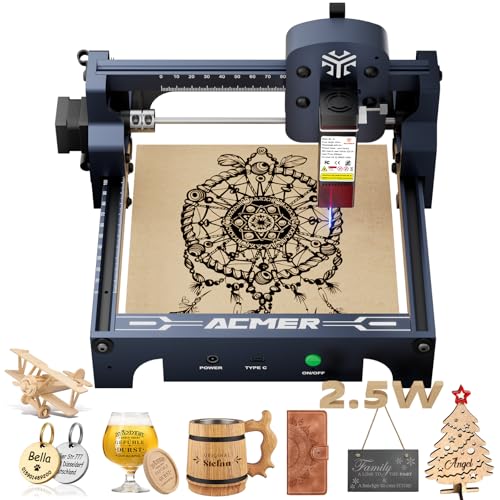
The 2500mW ACMER S1 option offers an approachable price point for budget-conscious users. It retains the 130×130 mm working area, 2 mm focal length, and 455±5 nm wavelength with a 10,000 mm/min engraving rate and 0.01 mm repeatable positioning accuracy. It is ideal for hobby projects and small business prototypes where affordability and basic reliability are priorities, with a focus on easy operation and quick setup.
Woxcker L2 Mini 10W Class 1

The Woxcker L2 Mini offers a modular, expandable platform with a true 10W-level capability. Its 200×150 mm bed suits small to mid-format pieces, and the design supports future upgrades like higher power heads, rotary modules, and additional beds. It emphasizes high-precision engraving (0.01 mm) and compatibility with various materials including wood, leather, acrylic, and metal-coated surfaces. This model is ideal for builders seeking scalable capability and a path to upgrades.
LONGER RAY5 5W Laser Engraver

Longer’s Ray5 5W laser engraver brings a balance of power and usability in a 400×400 mm workspace. With an 0.08×0.08 mm laser spot and 0.01 mm engraving precision, the machine supports high-detail work on wood, metal, acrylic, and glass. It uses a 240MHz ESP32-based control system for efficient processing, and the large working area accommodates bigger projects while retaining a compact desktop footprint. It is aimed at serious hobbyists and semi-professional makers seeking dependable performance.
Carverall K15 Pro 5W
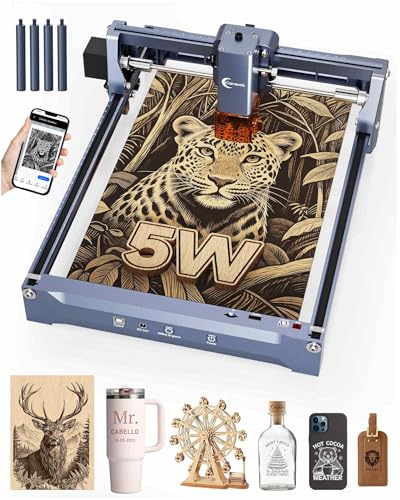
The Carverall K15 Pro offers real 5W output with a 200×300 mm bed and 0.01 mm precision. It is designed for beginners and DIY enthusiasts who need reliable engraving and cutting on wood, coated metal, and acrylic. The package includes necessary safety and setup accessories and supports modern software compatibility, including options like LightBurn and LaserGRBL. It emphasizes quick assembly and straightforward operation for project-based work.
Longer RAY5 20W High-Power Option

Longer’s 20W variant pushes into higher-output territory, enabling deeper cuts and faster material removal on wood, acrylic, and some metals. It retains a 400×400 mm bed, 0.01 mm engraving accuracy, and an ESP32-based control system for efficient multi-machine workloads. This option suits users who require more production capability while staying within a consumer-friendly price range.
Buying Guide: Key Purchase Considerations
- Power and materials: Higher wattage enables thicker cuts and faster processing but costs more. Match power to typical materials you plan to work with.
- Working area: Larger beds support bigger pieces. Consider your usual project sizes and future expansion needs.
- Precision and repeatability: Look for claims of 0.01 mm or better; this directly affects fine details in jewelry, engravings, and signage.
- Ease of use: Preassembled systems save setup time. Beginner-friendly software compatibility (LightBurn, LaserGRBL) helps minimize the learning curve.
- Upgrade paths: Expandable modules (rotaries, air assist, raised beds) add versatility as skills grow.
- Safety and class: Many consumer models are Class 1 or include protective features; verify safety standards and include protective eyewear in the package.
- Software ecosystem: Check compatibility with Windows, macOS, and popular engraving software. Community support can simplify troubleshooting.
- Maintenance: Consider availability of spare parts, replacements lenses, and the ease of cleaning and alignment.
- Total cost of ownership: Factor in consumables, replacement tubes or diodes, and power consumption for longer-term budgeting.
Material Considerations
Wood, acrylic, leather, and some metals respond well to laser cutting and engraving at these price points. Delicate materials may require lower power settings and slower speeds to avoid scorching. For coated or reflective metals, validate compatibility with the specific diode wavelength and focal length provided by the unit.
Usage Scenarios
Recommended use cases include hobbyist crafts, personalized gifts, DIY signage, educational projects, and small-batch product prototyping. For budding entrepreneurs, models with expandable beds and compatible software networks provide a scalable path.