Choosing the right airbrush primer is essential for model painting, ensuring adhesion, a smooth surface, and accurate color results. This article reviews top Vallejo and other popular primers ideal for plastic miniatures, figurines, and scale models. Each pick offers fast drying, compatibility with airbrushing, and a durable finish suitable for subsequent paints and details.
| Product | Brand | Finish | Volume | Notes |
|---|---|---|---|---|
| Vallejo Surface Primer Black | Vallejo | Matte | 200 ml | Ideal for dark underlayers and shadow work |
| Vallejo Surface Primer Grey | Vallejo | Matte | 200 ml | Balanced base for mid-tone painting |
| Vallejo Surface Primer Grey (60 ml) | Vallejo | Matte | 60 ml | Smaller bottle for quick projects |
| Badger SNR-410 Stynylrez Primer | Badger | White/Gray/Black | 4 oz | Self-leveling; versatile on multiple substrates |
| Nicpro Grey Surface Primer | Nicpro | Grey Matte | 250 ml | Ready-to-spray; pre-diluted for ease |
Vallejo Surface Primer Black — Matte, Quick Dry

Vallejo Black Primer is a matte acrylic primer designed for airbrushing on plastic models and figurines. It requires a degreased surface for best adhesion and dries quickly to a hard, uniform film. The primer can be used directly or diluted with Vallejo Airbrush Thinner or Flow Improver, enabling adjustable viscosity for different spray pressures. Recommended airbrush settings fall around 15–20 PSI (0.5–1 kg). This primer is part of Vallejo’s acrylic primer family, known for good hardness and adhesion on a variety of model surfaces.
Vallejo Surface Primer Grey — Matte Finish

Vallejo Grey Primer provides a neutral base ideal for mid-tone painting, with a matte finish and fast drying. As with other Vallejo primers, ensure the model surface is clean and free from release agents before priming. This acrylic primer is formulated for airbrushing, with recommended compressor settings around 15–20 PSI. It dries to form a consistent, hard film in a few hours and can be thinned with Vallejo Airbrush Thinner or Flow Improver to adjust spray behavior.
Vallejo Grey Primer, 60 ml — Matte Finish

This smaller Grey Primer from Vallejo offers the same matte finish and rapid drying, ideal for smaller projects or testing primers on miniatures. It shares the same airbrush compatibility and dilution options, allowing for flexible application with standard airbrush equipment. Like all Vallejo primers, a degreased surface and clean preparation enhance adhesion and finish quality.
Vallejo Black Primer 60 ml — Matte

A compact Black Primer suitable for darker underlayers, this option is designed for airbrushing on plastic models and scale figures. It dries quickly, forms a solid film, and can be diluted with Vallejo Airbrush Thinner or Flow Improver to achieve desired spray characteristics. As with other Vallejo primers, surface preparation is key for optimal adhesion and finish.
Badger SNR-410 Stynylrez Primer — White/Gray/Black
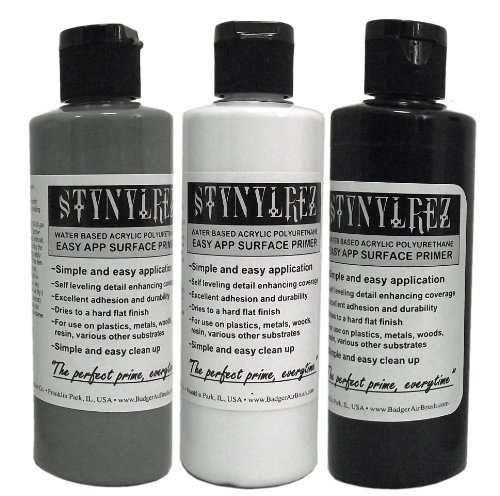
Badger’s SNR-410 Stynylrez is a water-based, polyurethane-enabled primer renowned for self-leveling properties and an easy spray experience. Available in white, gray, and black, it delivers excellent adhesion and durability on plastics, metals, wood, and resin. It dries to a hard, flat finish, making it suitable for a wide range of painting techniques and hobby substrates. Cleanup is straightforward, and it supports good detail definition.
Nicpro Grey Surface Primer — Matte
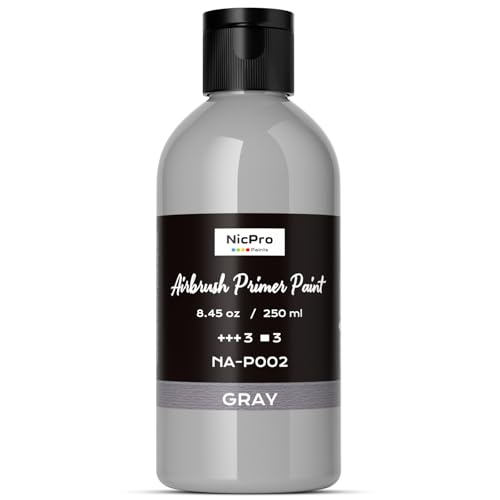
Nicpro Grey Primer is a ready-to-spray, water-based acrylic primer designed for beginners and professionals. The grey color aids coverage of darker topcoats and helps reveal surface imperfections early. It’s pre-diluted for airbrush use and dries to a durable matte film. The formulation emphasizes adhesion to plastic surfaces and is compatible with airbrush equipment and brush application if needed.
U.S. Art Supply Primer Set — Black, White, Gray

This three-color primer set provides black, white, and gray primers in convenient 4-ounce bottles. Designed for airbrushing, the water-based acrylic polyurethane formulation offers self-leveling properties and strong adhesion across plastics, metals, canvas, and other substrates. It’s suitable for priming mixed-media models and is compliant with standard safety and usage guidelines for hobby primers.
Buying Guide: Key Considerations For Modelers
When selecting an airbrush primer for plastic models, consider these factors to align with your painting goals and technique preferences.
- Finish type: Matte primers reduce glare and hide minor surface imperfections, while gloss primers can enhance color vibrancy on certain schemes. White, gray, black, and gloss black finishes offer different starting tones for varied projects.
- Surface compatibility: Most primers are formulated for plastic surfaces but verify compatibility with metal, resin, and resin-based figurines if you work with mixed materials.
- Application method: All listed primers are designed for airbrushing; some are ready-to-spray, while others may require thinning. Check your compressor settings and nozzle size to achieve a smooth, even coat without runs.
- Drying time and recoat windows: Fast-drying formulas enable quicker project turnover but may require precise timing to avoid solvent entrapment. Recoating intervals ensure a uniform film and minimize texture.
- Adhesion and substrate preparation: Clean, degreased surfaces cure best. Any release agents or oils must be removed prior to priming to guarantee maximum adhesion and film integrity.
- Volume and cost efficiency: Larger bottles (200 ml) offer longer project longevity, while smaller bottles (60 ml) can be useful for testing primers on trial models or for space-limited workspaces.
- Dilution and compatibility: Many Vallejo primers pair with Airbrush Thinner or Flow Improver to adjust viscosity and spray behavior. Ensure compatibility if you switch brands or tools.
- Color strategy: Light primers (white or gray) are typically used for brighter topcoats and easier color balance, while black primers enhance shadows and contour definition under darker schemes.
- Cleanup and maintenance: Self-leveling formulas reduce brushstrokes and texture, but all primers should be cleaned from the airbrush promptly to prevent clogging and ensure tool longevity.
- Safety considerations: Use in a well-ventilated area and follow label instructions. Some products may require storage in controlled conditions to maintain performance.