Explore key Barbara Brackman quilt pattern resources that illuminate American history, block design, and reproduction fabrics. This guide highlights four essential books and kits rooted in Brackman’s extensive research, offering historical context, practical techniques, and ready-to-use patterns for quilters of all skill levels. Each pick presents unique Anglophone and North American design perspectives, from Civil War era blocks to state and provincial motifs.
| Product | Brand |
|---|---|
| Encyclopedia of Pieced Quilt Patterns (3rd Edition) | Electric Quilt |
| Barbara Brackman’s Civil War Sampler: 50 Quilt Blocks with Stories from History | C&T Publishing |
| America’s Printed Fabrics 1770–1890: 8 Reproduction Quilt Projects | C&T Publishing |
| Create Your Family Quilt: Using State Blocks and Symbols (Book & Design CD) | UNKNO |
Encyclopedia Of Pieced Quilt Patterns (3rd Edition)

The Encyclopedia Of Pieced Quilt Patterns (3rd Edition) serves as a comprehensive catalog of patterns used throughout American quilting history. With Brackman’s editorial expertise, this volume compiles blocks, motifs, and design families that recur across eras, making it a practical reference for both historical study and contemporary projects. The reference is rich in diagrams, naming conventions, and usage notes that help quilters select patterns aligned with reproduction fabrics or modern palettes.
Barbara Brackman’s Civil War Sampler: 50 Quilt Blocks with Stories from History

This collection pairs 50 quilt blocks with historical narratives from the Civil War era, reflecting Brackman’s emphasis on context and storytelling in quilting. Each block includes construction details and historical notes that enhance pattern selection for period-inspired quilts. The book is suitable for quilters who want to deepen their understanding of Civil War block families while learning traditional piecing techniques and appliqué basics often used in Brackman’s designs.
America’s Printed Fabrics 1770–1890: 8 Reproduction Quilt Projects

This volume explores early American fabrics and their influence on quilt design, offering eight detailed reproduction projects. It provides historic notes and photographs to help identify fabric dating and pattern lineage, making it a valuable resource for collectors and crafters seeking authentic period looks. The book also discusses condition considerations and sourcing strategies for reproductions to support Brackman-style block sets and coordinated quilts.
Create Your Family Quilt: Using State Blocks and Symbols
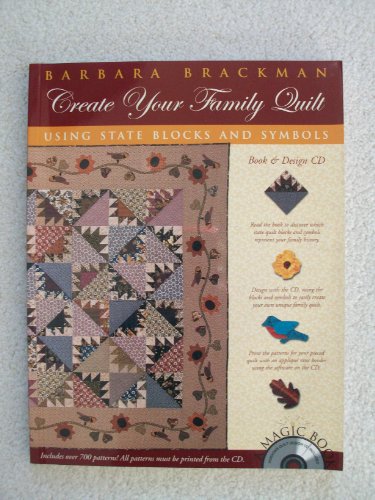
Brackman collaborates on a guide that traces state quilt blocks and symbols, inviting quilters to weave family history into their fabric projects. The included design CD and references to Electric Quilt’s software empower users to plan blocks, assemble patterns, and print templates for precise piecing. The book blends historical lore with practical techniques for appliqué and piecing, enabling customized family quilts that reflect regional heritage.
Buying Guide
When selecting Barbara Brackman quilt pattern resources, consider the following:
- Historical focus vs. practical project scope: Some books emphasize historical context and block lineage, while others provide ready-to-make projects. Choose based on whether you want research depth, pattern variety, or both.
- Block families and motifs: Brackman’s work centers on Civil War era blocks, state blocks, and reproduction fabrics. Look for volumes that align with your preferred era, palette, and fabric availability.
- Pattern accuracy and diagrams: For effective piecing, clear diagrams and step-by-step instructions are essential. Verify that the book includes comprehensive diagrams, template shapes, and finishing guidance.
- Supplemental tools: Some editions include CDs or references to software like Electric Quilt. If you use digital planning, confirm compatibility and included blocks or templates.
- Condition and sourcing: For out-of-print or used volumes, check condition notes and availability of reproductions. Brackman’s reference works are often sought after by collectors and serious quilters.
- Project adaptability: Consider whether the patterns can be scaled, recolored, or reinterpreted with modern fabrics while preserving historical integrity.
- Educational value: If you teach or study textile history, look for titles with detailed historical notes, anecdotal histories, and bibliographies to support deeper learning.
Choosing a Brackman-focused resource depends on whether you prioritize heritage storytelling, block-learning, or practical quilt-making. The four selections above provide a spectrum of historical insight and actionable projects, supporting both research-driven and design-forward quilting approaches. For a cohesive Brackman-inspired collection, pair a historical reference with a practical project book to bridge theory and technique in your next quilt.