For durable repairs and reinforced surfaces, fiberglass cloth and epoxy-compatible fabrics are essential. This guide highlights five high-quality options, detailing their uses, strengths, and how they fit common epoxy projects—from boat hull repairs to model aircraft skinning. Use this overview to compare weave types, thickness, and sizing, and choose the cloth that best matches your resin system and project requirements.
| Product | Brand | Size | Weave / Type | Ideal Use |
|---|---|---|---|---|
| SICCOMA Fiberglass Cloth Roll Non Adhesive | SICCOMA | 2 in x 99 ft | Plain weave, non-adhesive | Pipes, seams, boat repairs, molding, reinforced joints |
| Acuteye Fiberglass Cloth Roll | Acuteye | 2 in x 99 ft | Plain weave, non-adhesive | Repairing pipes, sinks, boats, larger surfaces |
| SATINIOR 2 Pcs Fiberglass Cloth | SATINIOR | 47″ x 80″ per piece (2 pieces) | Lightweight cloth, 0.75 oz, plain weave | Model aircraft, RC projects, lightweight skinning |
| mychoiii 1708 Biaxial Fiberglass Cloth | mychoiii | 50″ x 120″ (approx.) | 1708 biaxial | Structural reinforcement, high strength applications |
| SIMPLYHARDWARE 8″ Wide Fiberglass Cloth Roll | SIMPLYHARDWARE | 8″ x 360″ (10 yd) | 1708 biaxial | Marine, molding, repair, epoxy compatible |
SICCOMA Fiberglass Cloth Roll Non Adhesive

Woven fiberglass cloth with plain weave, selvage edge and non-adhesive backing. Each roll measures 2 inches in width and 99 feet in length with a thickness around 0.13 mm (5 mil). Suitable for pipe winding, seams, cracks, boat building, molding, and other reinforced areas. This cloth provides a stable substrate for saturating with epoxy or polyester resins, enabling robust layups without adhesive interference.
SICCOMA Fiberglass Cloth Tape Non Adhesive (4 in x 99 ft)

Plain weave E-glass cloth tape with selvage edge and non-adhesive backing. The 4-inch width and 99-foot length make it convenient for larger seam repairs, reinforcing joints, and resin-saturation work on boats, pipes, and molded surfaces. Its non-adhesive nature allows resin to fully saturate the fabric for a clean, strong finish.
mychoiii 1708 Biaxial Fiberglass Cloth

Featuring a premium 1708 biaxial weave, this cloth provides balanced strength in both 0° and 90° directions. With total reinforcement from two continuous fiber layers and a chopped strand mat, it offers high tensile strength and impact resistance. Ideal for structural repairs, decks, automotive applications, and other demanding epoxy projects where stiffness and strength are critical.
SIMPLYHARDWARE 1708 Fiberglass Cloth Roll

This 1708 biaxial fiberglass mat is a marine-grade reinforcement option compatible with epoxy, polyester, and vinyl ester resins. It is commonly used for molding, roofing, boat repairs, and general resin applications where durable skin reinforcement is required. The roll format supports large-area layups with consistent reinforcement across surfaces.
Fiberglass Mat 50 in x 30 ft (VIKEYTIM)
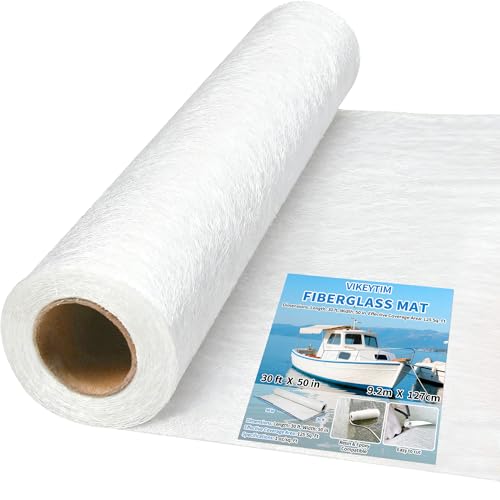
Fiberglass chopped strand mat designed for resin and epoxy compatibility, with a roll design that unfolds into a full surface. It covers large areas efficiently and helps achieve uniform wet-out and reinforcement for boat hulls, roofing, and other composite structures requiring even thickness and strength.
Buying Guide
- Weave and thickness: Plain weave cloths are simple and easy to saturate, while biaxial (1708) fabrics provide balanced strength in multiple directions. Choose based on load paths and resin system.
- Adhesive vs. non-adhesive: Non-adhesive cloths rely on resin wet-out for matrix bonding, which can simplify application but may require more careful placement. Adhesive-backed fabrics are less common in pure repairs and may affect resin penetration.
- Resin compatibility: Most options are epoxy-compatible, but verify resin compatibility (epoxy, polyester, vinyl ester) for best results and minimal chemical reaction risks.
- Thickness and weight: Thinner cloths (e.g., 0.03 mm) minimize added weight and improve surface finish for fillets and skinning, while thicker or biaxial fabrics provide higher strength for structural repairs.
- Project type: For lightweight RC models or delicate surfaces, opt for lighter cloth like 0.75 oz; for boats, decks, or structural repairs, biaxial 1708 fabrics offer superior reinforcement.
- Cutting and handling: Pre-cut panels or rolls with selvage edges reduce fraying and simplify layups. Ensure you have sharp scissors or a rotary cutter for clean edges.
- Coverage and waste: Calculate surface area and resin-to-fiber ratio to estimate material needs. Rolls with wider widths reduce seams on large surfaces.
- Safety: Wear eye protection, gloves, and a well-ventilated area when working with resins and fiberglass to prevent skin and eye irritation.