The following selections highlight standout glass engraving machines that deliver clean, detailed results on glass and other hard materials. Each option combines robust laser power, precise focusing, and user-friendly features to support hobbyists, crafters, and small businesses. Use this guide to compare capabilities, safety features, and expansion potential before choosing a model that fits your glass engraving goals.
| Product | Brand | Laser Power | Bed/Working Area | Notes |
|---|---|---|---|---|
| ACMER S1 (3500mW) | ACMER | 3.5W | 130x130mm | High precision, versatile for wood, acrylic, metal, glass |
| ACMER S1 (6000mW) | ACMER | 6.0W | 130x130mm | Greater depth and speed, similar versatility |
| Longer Ray5 (10000mW) | Longer | 10W | 400x400mm | High throughput, color-capable engraving |
| Woxcker L2 MAX (10W) | Woxcker | 10W | 300x300mm | Enclosed design with safety and 0.01mm precision |
| LONGER Ray5 (5W) | Longer | 5W | 400x400mm | Balanced power and large work area |
ACMER S1: 3500mW, 130x130mm Bed

The Acmer S1 3500mW model emphasizes high-precision engraving with a compact 130x130mm working area. Its diode laser operates at 455±5nm with a 2mm focal length, delivering fine details suitable for glass, wood, acrylic, and metal substrates. With a claimed speed up to 10,000mm/min and sub-0.01mm repeatable positioning accuracy, it supports intricate glass decorations such as etched monograms and decorative patterns. The unit is designed as a two-in-one engraver and cutter, enabling both engraving and light cutting on compatible materials. It ships largely preassembled for quick setup, making it accessible to beginners while remaining capable for more involved projects.
ACMER S1: 2500mW, 130x130mm Bed
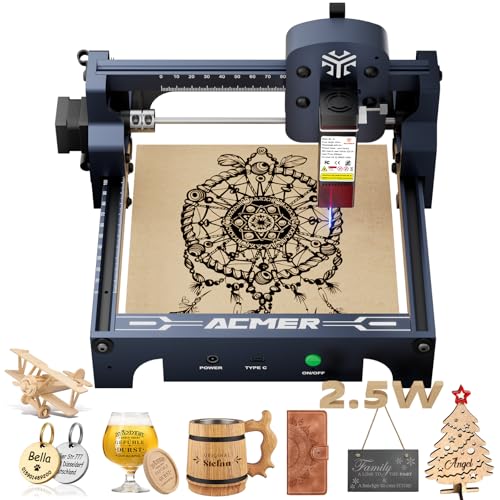
The 2500mW variant mirrors the 3500mW model with a 130x130mm workspace and 2mm focal length, suitable for medium-detail glass engraving alongside wood, leather, and acrylic. The device maintains a 0.01mm repeatable positioning precision, enabling crisp lettering and decorative patterns on glassware and plaques. The dual-function design supports both engraving and cutting tasks, providing flexibility for DIY crafts, small business projects, and classroom demonstrations. Quick assembly and beginner-friendly operation make it a practical entry point for glass enthusiasts exploring precision etching.
ACMER S1: 6000mW, 130x130mm Bed

The 6000mW version increases output to deliver deeper and faster engraving on glass, as well as wood and other materials, maintaining the same 130x130mm bed and 0.01mm positioning accuracy. This model suits small-batch glass projects, including etched logos on highball glasses or decorative panels. Like the lower-powered variant, it offers a 2-in-1 engraving and cutting capability and arrives largely preassembled for minimal setup. The enhanced power makes it more resilient to longer sessions and more demanding design iterations.
Longer Ray5: 10000mW, 400x400mm

This Longer Ray5 model elevates power to 10W and expands the working area to 400x400mm, enabling large-format glass engravings and deeper cuts. It features an in-house 256-color palette for potential color-engraved accents and a precise 0.01mm engraving resolution. The device relies on a capable ESP32-based control system that supports multi-machine operation, making it suitable for workshops or studios that run multiple units in parallel. A sizable bed makes it well-suited for plaques, glass panels, and bottle engraving with detailed borders and shading.
Woxcker L2 MAX: 10W Enclosed System

The Woxcker L2 MAX combines a fully enclosed design with 10W of laser power, focusing on safety and reliable performance. An enclosure reduces exposure risks and helps manage fumes during glass engraving. The 0.01mm ultra-fine compression fixed focus ensures crisp, high-contrast results on glass, stainless steel, wood, plastic, and more. The 300x300mm bed supports a range of glass items from coasters to panels. This model includes safety features and a robust structure suitable for home studios and small fabrication shops that require dependable operation with minimal oversight.
Longer Ray5: 5W, 400x400mm

The Longer Ray5 5W model delivers a balance of power and a large workspace, with a 400x400mm bed and 0.08mm spot size. It provides up to 10,000mm/min engraving speed and 0.01mm precision, making it suitable for glassware, tempered glass panels, and decorative items. Users can pair the machine with external software such as LaserGRBL or LightBurn, taking advantage of the open-system approach while benefiting from an included touchscreen or offline operation. This configuration is a strong option for studios needing a versatile, mid-range power laser with plenty of room for growth.
Buying Guide: Glass Engraving Laser Machines
Key considerations help buyers choose a model that meets their glass engraving needs while balancing safety, cost, and future expansion.
- Power and material capability: Glass engraving typically benefits from higher wattage for deeper or faster engravings. For simple personal projects, 2.5–5W may suffice, while 6–10W units handle thicker glass or bulk tasks more efficiently.
- Working area: Smaller beds are excellent for coasters and glassware, but larger projects like glass panels, tiles, or decorative screens require bigger beds (400x400mm or larger).
- Precision and focus: Look for a fixed focus or adjustable focus with a stable z-height to maintain consistent engraving depth. 0.01mm precision is common in quality units and helps produce crisp lettering and intricate patterns on glass.
- Safety features: Enclosures, lid interlocks, flame sensors, and emergency stops reduce risk when engraving glass, which can produce sharp shards and fumes depending on materials used and power settings.
- Ease of setup: Preassembled units speed up deployment, especially for beginners. Consider suppliers offering setup guides, customer support, and warranty terms.
- Software compatibility: Ensure compatibility with popular engraving software (e.g., LaserGRBL, LightBurn) and the ability to export common vector formats for precise glass designs.
- Expansion and customization: Modules such as rotary attachments for cylindrical glass objects, air assist, honeycomb beds, and risers expand capabilities for diverse projects.
- Noise, heat, and maintenance: Enclosed systems typically reduce noise and contain fumes. Regular maintenance of lenses, mirrors, and mechanical bearings extends machine life.
- Cost of ownership: Beyond initial price, factor laser tube or diode lifespan, replacement parts, and software updates into long-term budgeting.
For glass engraving, users should assess not only the raw power but also stability, focus consistency, and safety. Machines with a balanced combination of power, large working areas, and robust safety features tend to deliver durable results across a range of glass types—from drinkware to decorative panels. Consider your typical project size, desired throughput, and whether you anticipate expanding capabilities with add-ons or additional units in a workshop setting.