Choosing the right metal name tag maker depends on wheel size, material compatibility, and marking depth. This guide highlights five top options for American buyers, focusing on reliability, ease of use, and durability for labeling metal plates, dog tags, and PVC cards. Explore features, compare capabilities, and find the best fit for professional or personal projects.
| Product | Brand | Character Wheel | Notes |
|---|---|---|---|
| Consfly Metal Nameplate Stamping Machine (5mm Wheel) | Consfly | 5mm | High-frequency quenched wheel; 0.1-0.3mm depth |
| MXBAOHENG Metal Nameplate Stamping Machine (6mm Wheel) | MXBAOHENG | 6mm | Die-steel wheel; 40 characters; 0.1-0.3mm depth |
| MXBAOHENG Metal Nameplate Stamping Machine (4mm Wheel) | MXBAOHENG | 4mm | Same wheel composition; height varies with wheel size |
| DNYSYSJ 400W Electric Metal Marking Machine | DNYSYSJ | Not wheel-based | Electric marking; adjustable depth and speed |
| Aotuse Manual Stamping Machine (5mm) | Aotuse | 5mm | High-quality chromium steel wheel; durable impressions |
Consfly Metal Nameplate Stamping Machine (5mm Wheel)

The Consfly 5mm model operates on a simple stamping principle: external force presses a heat-treated alloy steel wheel that engraves letters or numbers on metal plates. The wheel can be rotated to select characters, and spacing is adjustable with manual tweaks. A single wheel includes 40 characters: 10 numbers, 26 uppercase letters, and 4 common symbols. Deep yet crisp impressions are produced at about 0.1–0.3 mm. Suitable for metal plates and dog tags, it supports medium-scale labeling tasks with straightforward operation.
MXBAOHENG Metal Nameplate Stamping Machine (6mm Wheel)

This MXBAOHENG model features a robust die-steel character wheel with 40 characters: 26 uppercase letters, 10 numbers, and 4 symbols. The wheel height is 6 mm, and the device supports 0.1–0.3 mm engraving depth. The wheel’s durable construction enables consistent impressions, and characters can be swapped by changing wheels to align with project needs. It’s well-suited for metal plates and PVC cards, offering reliable, legible results for industrial labeling applications.
MXBAOHENG Metal Nameplate Stamping Machine (4mm Wheel)
This variant uses a 4 mm character wheel with the same wheel construction and character set as the 6 mm option. It offers the same 0.1–0.3 mm engraving depth, ensuring legible marks on metal plates and PVC cards. The reduced wheel height enables labeling on thinner materials or tighter spaces, while maintaining the reliability typical of MXBAOHENG tools. It is a practical choice for projects requiring smaller type or more compact labeling gear.
DNYSYSJ 400W Electric Metal Marking Machine

This electric metal marking system provides a non-wheel approach to engraving. It supports various shapes including rectangular, sector, and round signs, with adjustable marking range, depth, and speed. The device runs on Windows software, offering robust editing functions for precise layouts. It’s designed for efficient, repeatable markings on metal plates and other substrates, reducing manual effort while enabling consistent results across batches.
Aotuse Manual Stamping Machine (5mm)
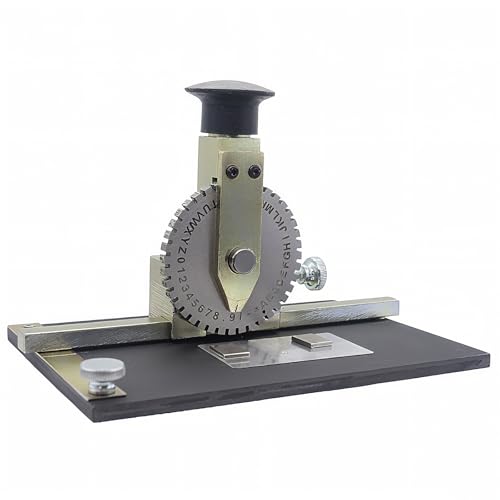
The Aotuse manual stamping tool uses a high-quality chromium steel wheel with 40 characters (26 letters, 10 digits, 4 symbols). The wheel is designed for durability and consistent impressions on stainless steel, aluminum, brass, or PVC cards. Impressions reach about 0.1–0.3 mm in depth, producing clear, long-lasting marks. The tool emphasizes straightforward operation: rotate to the desired character, then press firmly for a crisp imprint, suitable for frequent labeling tasks.
Buying Guide: Key Purchase Considerations
- Character wheel size and availability: Larger wheels yield taller characters (e.g., 6 mm), which can improve readability on bigger plates, while smaller wheels suit tight spaces (e.g., 4 mm or 5 mm).
- Engraving depth: Depths around 0.1–0.3 mm provide durable marks that resist wear; confirm compatibility with the target material (stainless steel, aluminum, copper, PVC).
- Material compatibility: Ensure the machine works with the intended substrates (metal plates, dog tags, PVC cards, aluminum, brass).
- Manual vs. electric operation: Manual tools are simple and portable; electric machines offer faster, automated marking with software support but may require a power source and setup.
- Durability and wheel material: Die steel or alloy wheels offer longer life and consistent impressions; heat-treated wheels resist wear during repeated use.
- Character set and symbols: Verify that the wheel includes essential characters, numbers, and symbols needed for your labels (some wheels omit lowercase letters).
- Replacement wheels and future proofing: Consider whether you can swap wheels easily to change character height and content for future projects.
- Ease of use and maintenance: Look for clear adjustment controls, stable bases, and straightforward alignment to prevent smudging and misprints.
- Cost of ownership: Assess wheel availability, replacement costs, and whether a wheel set covers your typical labeling needs.
- Safety and ergonomics: Manual stamping can require force; choose a design with comfortable handles and a stable stance to reduce fatigue.