Soluble or water-soluble filaments are a game changer for intricate 3D prints, enabling easy support removal and clean surface finishes on complex models. This guide highlights top soluble options that work well with common printers and materials like PLA, TPU, and nylon. Explore PVA-based filaments designed for dissolving supports, and compare key features to help you choose the right option for your projects.
Summary of selected products:
| Product | Brand |
|---|---|
| PolyDissolve S1 PVA Filament | POLYMAKER |
| PVA Filament 2.85mm – Water-Soluble | FUSED MATERIALS |
| RepRapper PVA Filament 1.75mm | RepRapper |
| RepRapper PVA Filament 1.75mm (AMS compatible) | RepRapper |
| AMOLEN Silk PLA Filament Bundle | AMOLEN |
Polymaker PolyDissolve S1 PVA Filament

PolyDissolve S1 PVA filament is a water-soluble support material designed for standard printing temperatures with PLA, TPU, PVB, and Nylon. It enables printing complex geometries, including internal cavities, multi-part mechanisms, and architectural details. The filament is wound to minimize tangles, vacuum-sealed with desiccant for moisture control, and packaged in updated 3.0 packaging with a recycled cardboard spool and box. Ideal for projects where easy post-processing of supports is critical.
Fused Materials PVA Filament 2.85mm
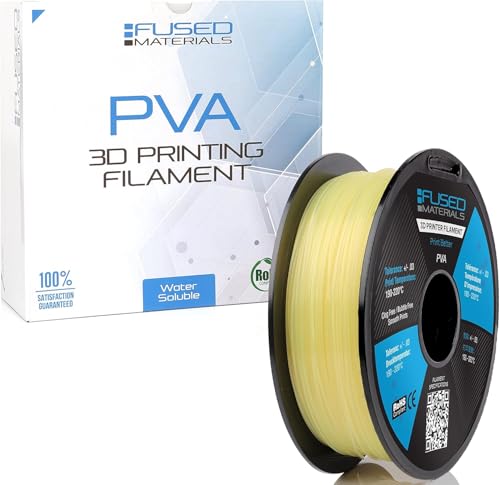
Fused Materials PVA is a premium water-soluble filament used as support for dual-extruder printers. It’s designed for ease of dissolving and strong performance with PLA, PETG, Nylon, and ABS depending on printer compatibility. The filament emphasizes better dissolvability, fewer bubbles, minimal warping, and tangle-free handling. It is ROHS and CE certified, making it a reliable option for intricate prints that require clean supports and straightforward post-processing.
RepRapper PVA Filament 1.75mm

RepRapper’s 1.75mm PVA filament is designed for use as support material and softens at 60-80°C water temperatures for easy manual removal without marring surfaces. It offers good thermal stability for complex models such as large overhangs and deep internal cavities. The filament is compatible with most FDM printers, with recommended nozzle and bed temperatures and print speeds that accommodate varied settings. A versatile option for printers needing reliable soluble supports.
RepRapper PVA Filament, 1.75mm For 3D Printer

Another RepRapper PVA variant focuses on compatibility with AMS systems, offering a 0.5kg spool and the same softening range to aid manual removal of supports. It emphasizes good thermal stability for complex models and broad printer compatibility. Printing guidance includes nozzle and bed temperatures, as well as a dry-storage protocol to maintain filament quality and performance over time.
AMOLEN Silk PLA Filament Bundle

AMOLEN Silk PLA is a multicolor silk-finish PLA filament bundle. While not a soluble support filament, it offers a vibrant, glossy surface suitable for visually appealing models and decorative pieces. The bundle includes four spools totaling 800 g, with a 1.75 mm diameter and tight tolerance. This option complements soluble-filament projects by enabling colorful, high-quality top surfaces on primary model parts printed with soluble supports used on other features.
Buying Guide
- Compatibility: Confirm that the soluble filament is compatible with your printer’s extruder (often 1.75 mm or 2.85 mm) and with the materials you’re printing. Dual-extruder setups benefit most from PVA supports, but some single-extruder printers can use soluble filaments with careful post-processing.
- Filament handling: Water-soluble filaments absorb moisture easily. Look for pre-dried, vacuum-sealed packaging and desiccants. Store spools in a dry environment and consider drying before use if moisture exposure is suspected.
- Wash and dissolve: The effectiveness of dissolution depends on temperature, water composition, and time. Many users dissolve supports in warm water (60–80°C) and may use agitation or overnight soaking for larger prints.
- Print settings: PVA and similar polymers require adjustments to bed temperature, nozzle temperature, and print speed. Start with manufacturer recommendations and tune for optimal adhesion, layer quality, and minimal stringing.
- Material quality and batch variation: Filament batches can vary in moisture content and diameter tolerance. Choose brands with consistent extrusion quality and tight dimensional tolerances to reduce nozzle clogging and misfeeds.
- Environmental and safety considerations: Soluble filaments dissolve in water, producing sludge. Ensure proper disposal and follow local guidelines. Keep work areas well-ventilated and wear appropriate safety gear when handling powders or fumes during printing.
- Application scope: Use soluble filaments for complex interiors, hidden channels, or intricate supports. For surfaces requiring exact finishes, pair soluble supports with post-processing steps such as gentle washing and surface smoothing.
- Cost-benefit analysis: Soluble filaments can add to printing costs. Assess your need for removable supports against the added material cost and potential post-processing time savings.